



Training & Capacity Building
ReSurge trains local reconstructive surgical teams in low-income countries across Africa, Asia, and Latin America — building lasting surgical capacity that serves communities long after our volunteers leave. Unlike short-term fly-in missions, our train-the-trainer model invests in local surgeons, nurses, and anesthesiologists who stay, teach, and continue to grow access to care for generations.
Surgical Team Training Trips
World-class volunteer surgeons from Stanford, Johns Hopkins, Yale, and UCSF travel to ReSurge training hubs to work side-by-side with local surgical teams — building skills and confidence that stay in the community permanently. Our teams facilitate around 20 teaching cases per week, focusing on the most complex cases while training every member of the surgical team at every stage of treatment. Pre-screenings and follow-up visits also happen virtually, extending the reach of every trip.
Telementoring & Virtual Training
Many colleagues in low-income countries are geographically isolated from their peers, and we work to bridge this gap via our telementoring programs. By leveraging technology, we can virtually connect with isolated surgical teams to provide crucial training. This program is constantly evolving, and we offer live virtual lectures from our expert medical volunteers, along with a database with hundreds of free lectures. We also work with Ohana One International Surgical Aid in providing augmented-reality smart glasses to our remote surgical teams, allowing mentors to instruct in real-time during procedures in the field.
Curriculum and Partnership
Sub-Saharan Africa has the most acute shortage of reconstructive surgeons. One of the ways we are changing this is by partnering with the largest surgical training institution in the region, The College of Surgeons of Eastern, Central, and Southern Africa (COSECSA) to create a new reconstructive surgery curriculum.This initiative promotes the standardizing of learning, testing, and certification processes across 14 countries. ReSurge also establishes long-term partnerships between hospitals in the United States and partner institutions across Africa.
The Multiplier Effect
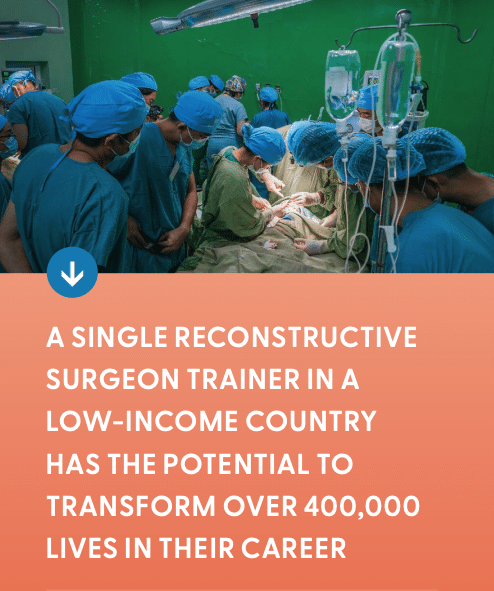
When ReSurge trains a reconstructive surgeon in a low-income country, we are not funding one career. We are setting off a chain reaction. A single surgeon will directly treat approximately 10,000 patients over their lifetime. But if that surgeon becomes a trainer — teaching the next generation of local surgeons — the impact multiplies across decades and borders.
Peer-reviewed research published in Plastic and Reconstructive Surgery – Global Open (2024) quantified this for the first time: one surgeon trained in a low-income country can impact over 400,000 lives through the multigenerational ripple effect of training. This is why ReSurge invests in training, not fly-in missions.
By the Numbers
We are working to improve the global surgery deficit by educating the next generation of reconstructive surgeons and growing capacity in low-income countries.
Here’s how our training programs impacted the world in 2024.
FAQs
ReSurge trains local reconstructive surgeons, anesthesiologists, nurses, occupational therapists, and pediatricians directly in the countries where they will practice. Rather than relying on fly-in surgical missions, ReSurge builds in-country capacity through hands-on training trips, residency and fellowship programs, virtual education, and eLearning centers — creating sustainable surgical systems that last long after any single visit.
ReSurge’s train-the-trainer model means that the surgeons we train don’t just treat patients — they go on to train the next generation of surgeons. This creates a multiplier effect that compounds over time: one trained surgeon treats thousands of patients over their career, and if they become a trainer, they can impact hundreds of thousands more through the surgeons and clinical teams they mentor.
The Multiplier Effect is ReSurge’s proven framework for measuring the multigenerational impact of surgical training, published in the PRS Global Open Journal in 2024 — the first peer-reviewed study of its kind in surgery or any hands-on medical field. A single ReSurge-trained reconstructive surgeon will directly treat an average of 10,000 patients over their career. If that surgeon becomes a full-time surgeon-trainer, they are projected to impact more than 400,000 lives through succeeding generations of trainees. Co-authored with Stanford’s Chief of Plastic Surgery, the study confirms that training locally is the most effective and sustainable path to closing the global surgical gap.
Fly-in surgical missions can provide immediate care, but they don’t build lasting capacity. When visiting teams leave, the surgical gap remains. ReSurge was one of the first global surgery organizations to move away from this model in the 1990s — prioritizing local training so that communities have permanent access to reconstructive care. Today, over 85% of all surgeries supported by ReSurge are performed by local partners, and the remainder are training surgeries performed by our expert team of best-in-class medical teaching volunteers.
Safe reconstructive surgery requires an entire team. ReSurge trains the full surgical ecosystem — reconstructive surgeons, anesthesiologists, nurses, pediatricians, and occupational therapists. This whole-team approach ensures that every patient receives skilled care from pre-operative evaluation through recovery, and that local health systems are strengthened at every level.
A ReSurge surgical hub is a fully developed in-country training center that serves as an anchor for regional surgical capacity building. Each hub includes surgical training trips, local partner surgeons, residency and fellowship programs, outreach camps to reach rural patients, eLearning centers, and biomedical engineering support.
Pioneering Women in Reconstructive Surgery (PWRS) is ReSurge’s flagship gender equity program, developed in partnership with SkinCeuticals. It provides two years of clinical training, leadership development, and mentorship to first-generation women reconstructive surgeons in low-income countries. Only 8.9% of surgeons in low-income countries are female — and in Sub-Saharan Africa, that number drops to 7%. Each cohort of six PWRS surgeons is projected to impact 162,000 patients over their careers.
ReSurge’s medical volunteers are world-class reconstructive surgeons, anesthesiologists, and other surgical specialists from leading academic medical centers including Stanford, Johns Hopkins, Yale, UCSF, Columbia, and more. They travel to our partner sites to perform training surgeries alongside local surgical teams — transferring skills, techniques, and knowledge that stay in the community long after they leave.
Meet ReSurge's Scholars and Partners
We are training the next generation of reconstructive surgeons who will change the world and impact their communities. Discover their life-changing stories below.
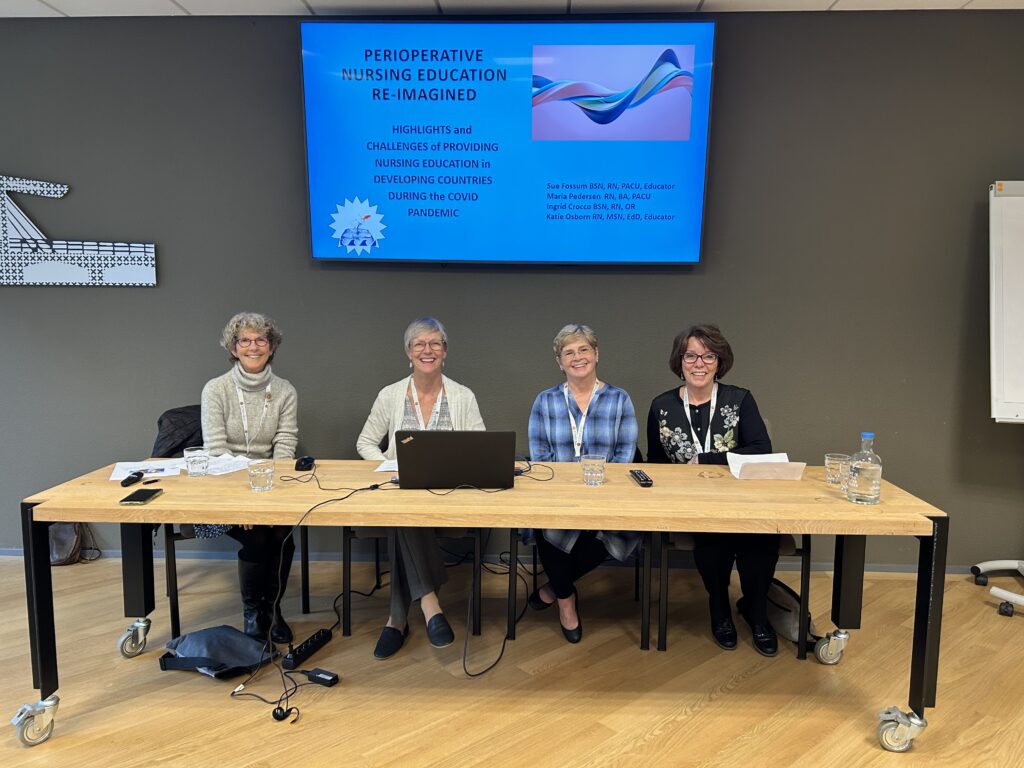
Nurses adapt to virtual training post-COVID, share insights at ICPAN...Read More
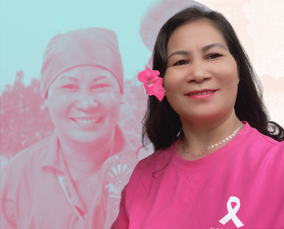
Son Hoang from central Vietnam wears many hats – a...Read More
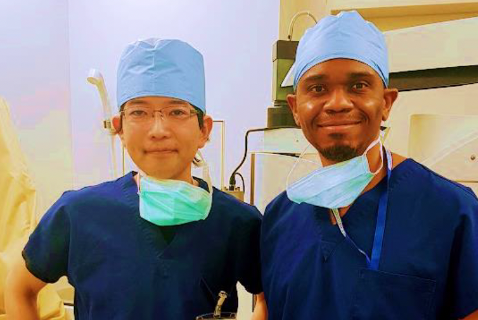
First Zambian plastic surgeon, Dr. Chihena Banda, receives support from...Read More
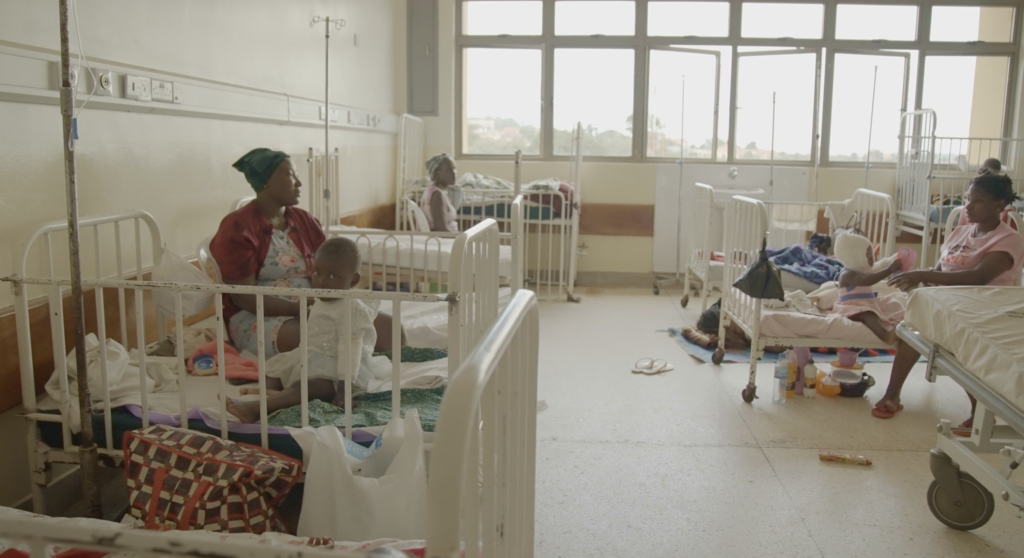
Discover ReSurge International: A Silicon Valley-based nonprofit tackling global surgical...Read More
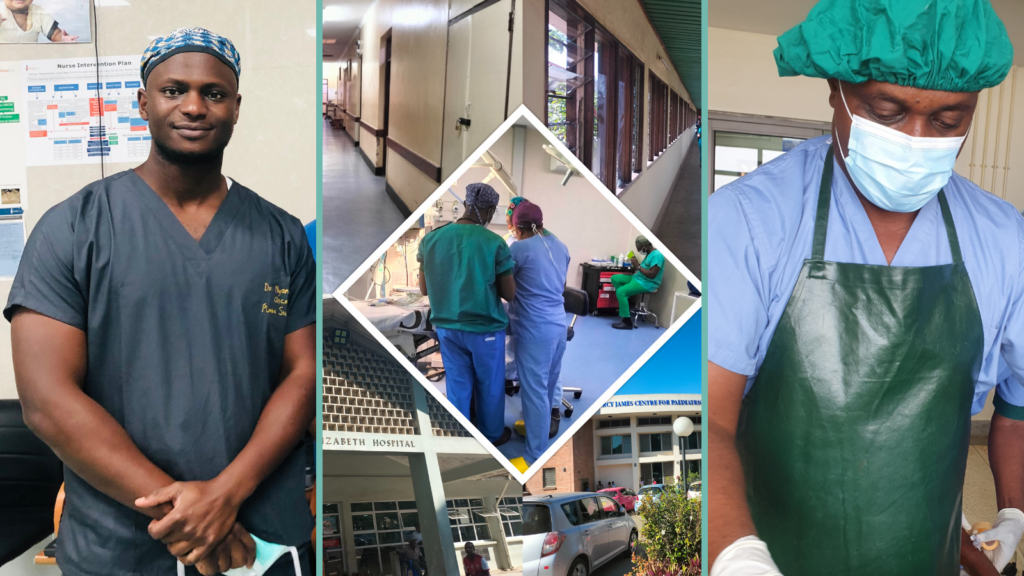
Today, five billion people live without access to surgical care....Read More

ReSurge International recently hosted Transformational Conversations: An Evening with Dr....Read More
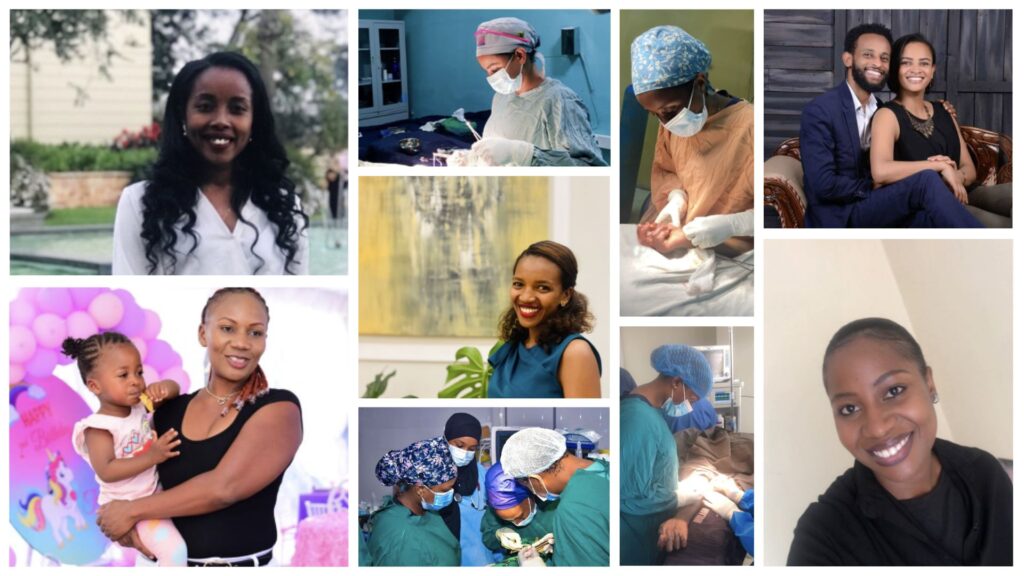
Meet the five winners of the 2023/24 Matolase Mtonga Scholarship!...Read More